

The Gentleman Futurist: Inside Julien Mercier's Mind
The last liberal tech billionaire is building a brain interface that could reshape human consciousness. He makes it sound like poetry.
By Brett Spencer
DAVOS, SWITZERLAND — Julien Mercier is apologizing for the coffee. Not because it's bad—we're in a private salon at the Steigenberger Grandhotel Belvédère, and the coffee is excellent—but because he's noticed I've nearly finished my cup and he hasn't offered a refill. "I'm terrible at this," he says, already signaling to the attendant. "My mother would be horrified. She always said Americans think the French are rude because we forget the small kindnesses."
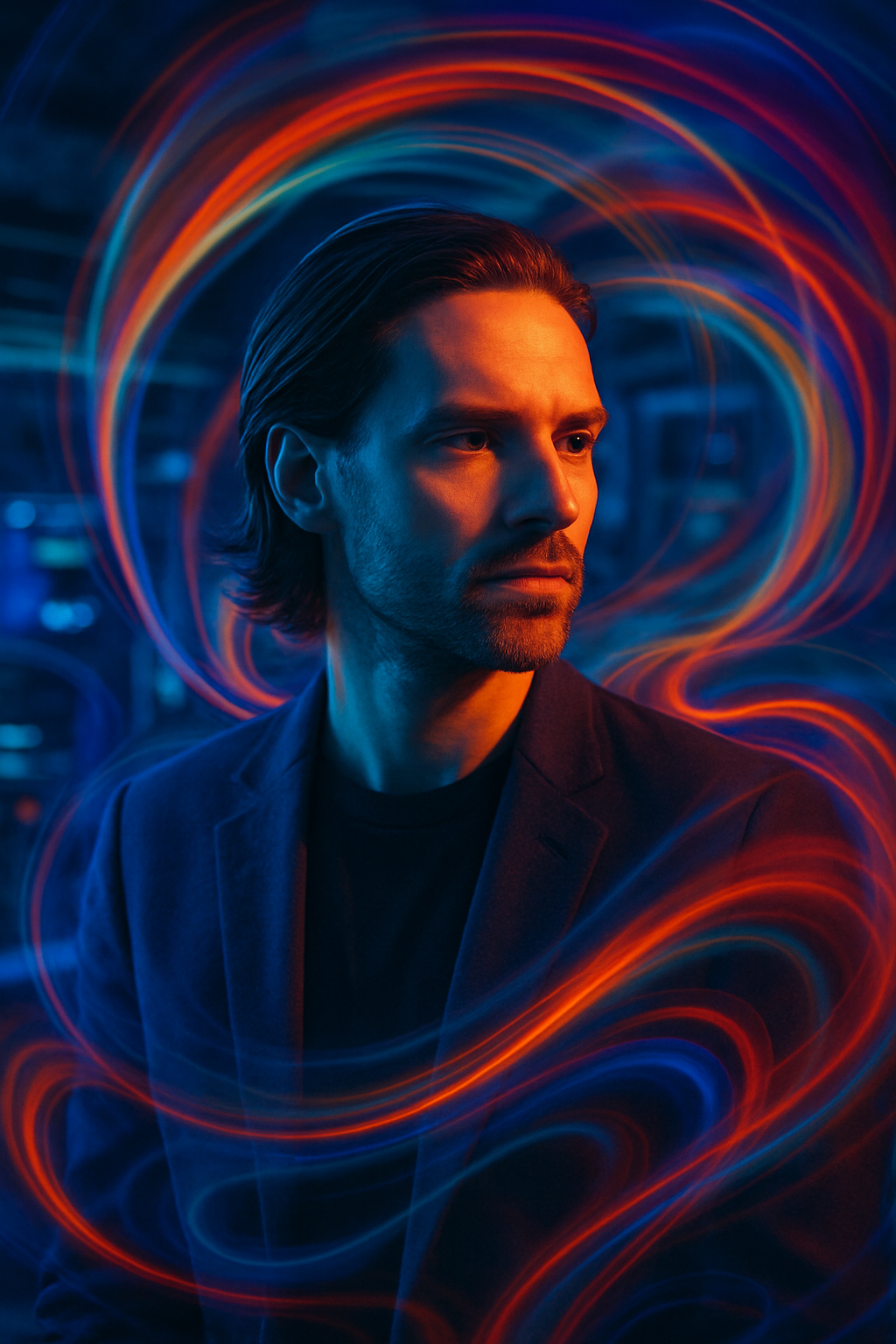
It's a minor moment, but it's characteristic. Over two hours of conversation, Mercier, 43, is unfailingly considerate, self-deprecating, and present in a way that's vanishingly rare among his cohort. He doesn't check his phone. He asks follow-up questions. When I mention I've been fighting jet lag, he spends five minutes describing his own sleep protocols with the earnest concern of a friend, not the evangelical fervor of an optimizer. "I know it sounds très californien," he says, smiling at his own accent on the English, "but magnesium glycinate before bed, it really does help."
This is not what you expect from the man who's about to unveil the Entanglion 3, the latest iteration of his company's direct neural interface technology. This is not the affect of someone proposing to wire your consciousness into the cloud.
But then, Julien Mercier has never been what you'd expect.
The Un-Bro
In an era when tech billionaires seem to be competing for who can most efficiently alienate half the planet, Mercier has maintained something anachronistic: likability. While his contemporaries post through it on X, Mercier publishes thoughtful essays on the ethics of enhancement technology in n+1 and The Point. While they're buying social networks and rocket companies, he's funding progressive policy institutes and avant-garde theater in Paris. He was an early signatory on the pledge against political donations, and he's never once appeared on Joe Rogan.
"Julien is from another time," says Dr. Aisha Patel, a bioethicist at Stanford who has consulted with Mercier's company, Entanglion Systems. "Or maybe from a parallel universe where Silicon Valley developed differently. He actually reads the critiques. He engages with them seriously."
The origin story is well-worn by now but worth revisiting. Mercier's father, Robert, was an American software engineer who met his mother, Sylvie, a literature professor, during a sabbatical in Lyon in the late 1970s. Julien grew up between two worlds—summers in Palo Alto, school years in the 6th arrondissement—fluent in both the garage-startup mythos and the French intellectual tradition that views American tech culture with bemused suspicion.
"I always felt like a translator," Mercier tells me. "Not just of language, but of worldviews. The French think Americans are naive about technology, too optimistic. Americans think the French are too pessimistic, too theoretical. I've always believed both sides have something to learn."
After studying computational biology at Stanford—where he met his ex-wife, the novelist Claire Whitmore, in a seminar on narrative and consciousness—Mercier did what ambitious biology students did in the early 2000s: he went into genomics. His first company, Genenetech Investments (no relation to the pharma giant), developed machine learning tools for analyzing genetic data. The company was acquired by Roche in 2014 for $740 million. Mercier walked away with enough to never work again.
Instead, he went deeper.
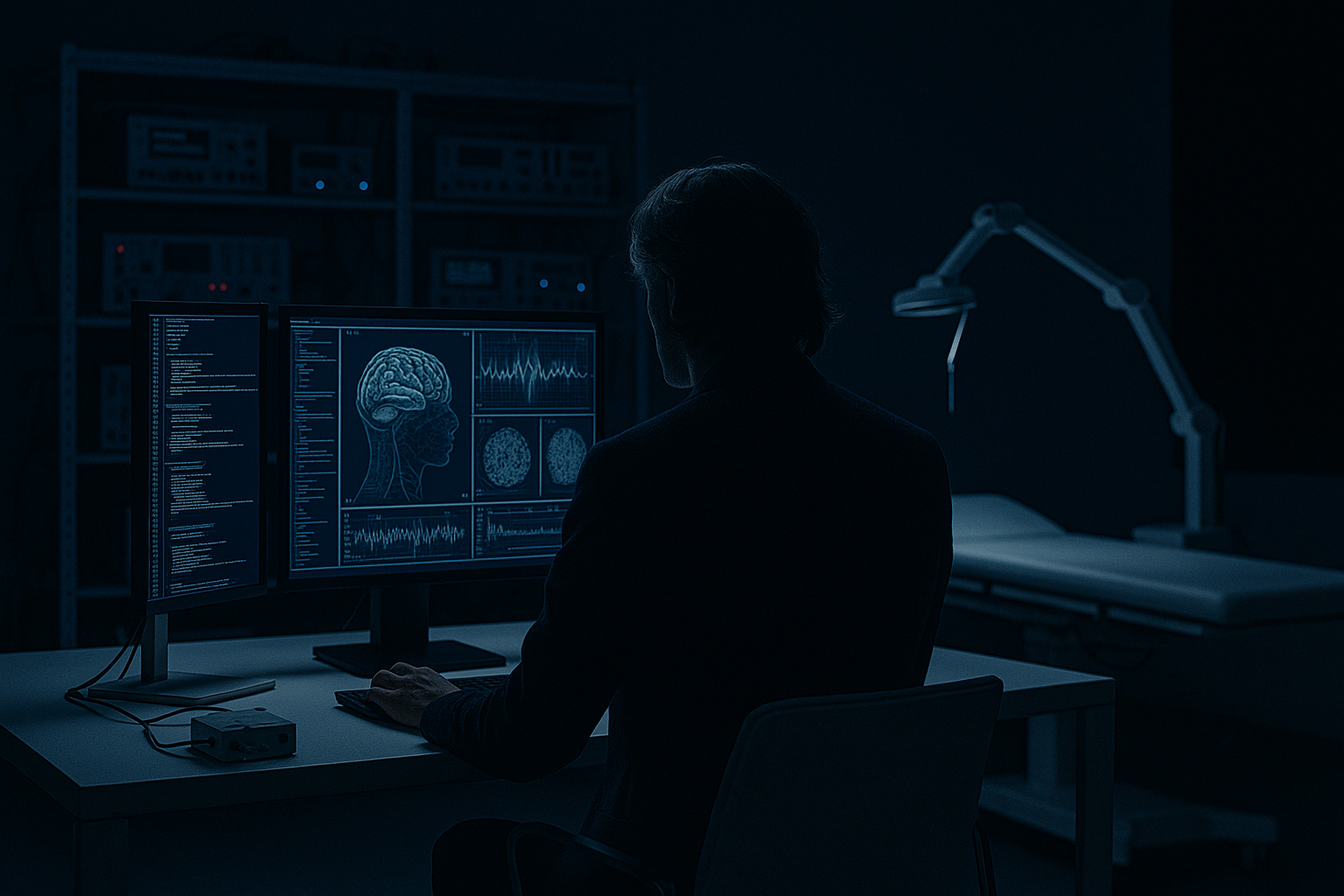
We like the dark
Reading His Way to the Brain
What Mercier did next surprised people who knew him as a competent but not visionary founder. He took a year off. He read. He traveled. He spent months at his family's cottage in Brittany, working through Proust again, reading Varela and Thompson on embodied cognition, diving into phenomenology and consciousness studies.
"I realized I'd been working on the data of life, but I hadn't really thought about what life is," he says. "What consciousness is. I'd been treating the mind as a computer to be optimized, but it's not that. It's something stranger, more fragile."
It was during this period that he assembled the team that would become Entanglion Systems, and began the work that would define the next chapter of his life.
The Terrible Paradise
Which brings us to Davos, and to the Entanglion 3.
For those not embedded in the neural interface community—a small but growing world of academics, engineers, and venture capitalists—the Entanglion has been the quiet leader in the field for the past five years. While competitors like Neuralink grab headlines with demonstrations and regulatory battles, Entanglion Systems has moved methodically, publishing peer-reviewed research, working within FDA frameworks, and avoiding the maximalist rhetoric that plagues the field.
The device itself is elegant in its minimalism: a subdural array no larger than a thumbprint, installed via a procedure Mercier describes as "slightly more involved than LASIK, slightly less involved than cataract surgery." The current generation, used in clinical trials for locked-in syndrome and severe paralysis, allows users to control external devices—wheelchairs, computer interfaces, robotic arms—with thought alone.
The Entanglion 3, which Mercier is unveiling to a small group of clinicians and investors at a private session tomorrow, goes further.
"We're moving from output to input," Mercier explains, his voice softening as it does when he's describing the technical work. "The first generation was about reading neural signals. The second generation added some stimulation capabilities for pain management. The third generation... we're beginning to write to the brain. To introduce information directly into conscious experience."
He pauses, seems to measure his next words carefully.
"We can induce specific qualia. Sensations. Memories, or things that feel like memories. We're working with subjective states that previously required years of meditative practice or, you know, heroic doses of psilocybin."
The applications, he says, are therapeutic. PTSD treatment through memory reconsolidation. Depression interventions through targeted mood elevation. Enhanced learning through direct encoding of information.
"Imagine," he says, eyes bright with the vision, "being able to grant someone the felt sense of mastery in a domain. Not just the information, but the confidence, the intuition that comes from deep expertise. Or imagine being able to give someone the direct experience of interconnection with others, the dissolution of ego boundaries that mystics describe. We could democratize enlightenment."
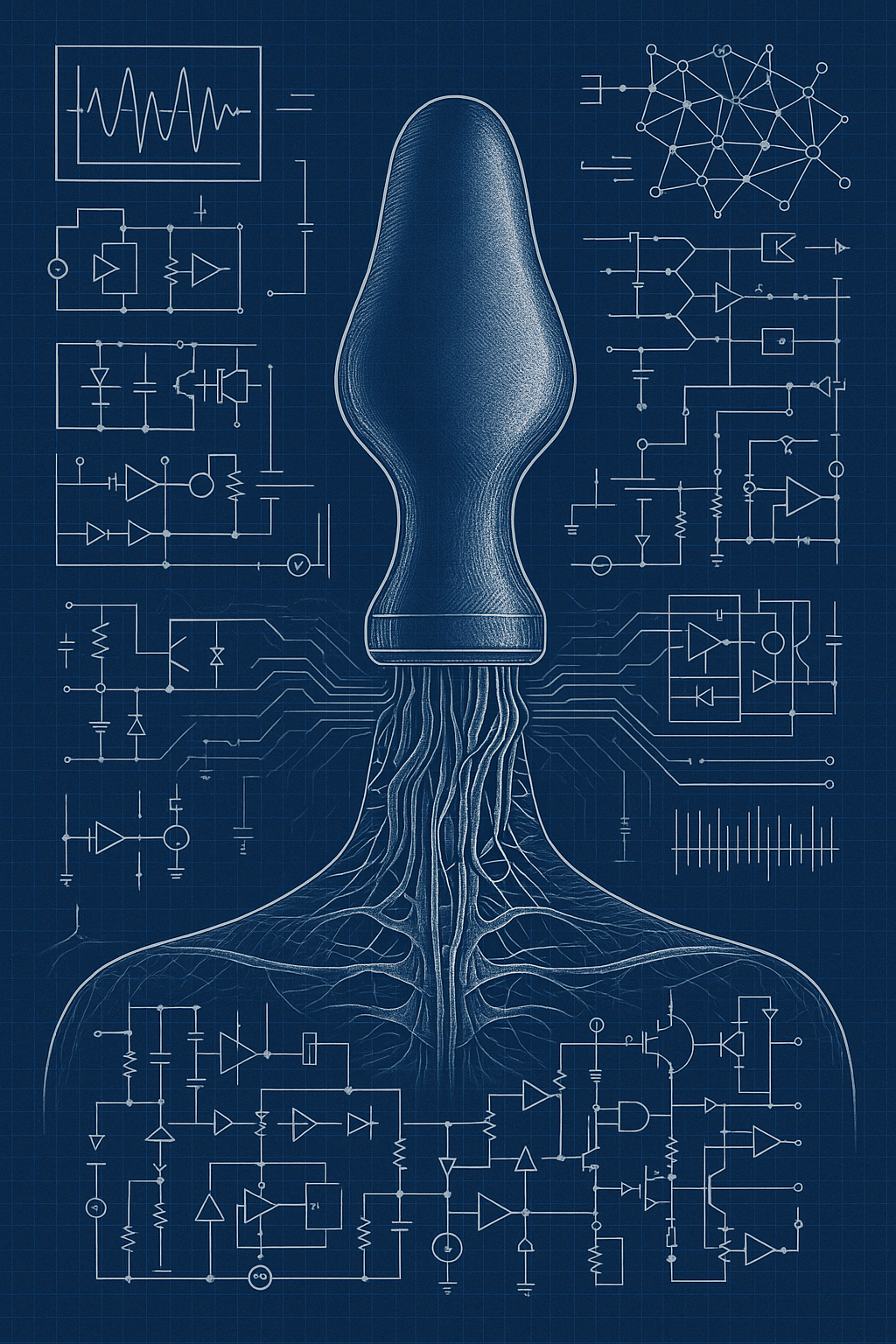
The Entanglion neural software connection matrix from an early Mercier sketch
The Sugar Coating
It's here, in the space between Mercier's gentle delivery and the implications of what he's describing, that something vertiginous opens up.
He's talking about writing to human consciousness. About introducing synthetic experiences that are indistinguishable from reality. About altering the felt sense of self. And he's talking about it the way one might discuss a particularly promising meditation retreat.
I push him on this. Isn't this exactly the scenario that makes ethicists wake up in cold sweats? The complete erosion of the boundary between authentic experience and engineered illusion?
"Yes," he says simply. "Yes, absolutely. This is terrifying technology. Which is why it matters enormously who builds it and how."
He leans forward, fully engaged now in a way that reminds me he's spent years thinking about these objections.
"Look, someone is going to build this. The technical path is clear. The question is whether it's built by people who see consciousness as a product to be disrupted, or by people who approach it with humility, with care, with the understanding that we're dealing with the most sacred aspect of human existence."
He describes the safeguards Entanglion has built: the ethics review boards with veto power, the commitment to transparency in research, the strict limitations on commercial applications. He talks about the philosophical framework he's developed with advisors from contemplative traditions, phenomenology, and neuroscience.
"We're trying to build something that respects human dignity," he says. "That enhances human flourishing rather than replacing it."
And yet.
In the technical documentation Mercier's team has prepared for tomorrow's presentation—which I've been given access to under embargo—the capabilities are stark. The Entanglion 3 can induce not just simple sensations but complex emotional states. It can modify risk perception, alter time perception, suppress doubt, enhance conviction. The papers are careful to frame these as therapeutic tools, but the technology doesn't know the difference between therapy and enhancement, between healing and optimization, between flourishing and control.
There's a slide in the deck titled "Applications in Workforce Productivity." Another on "Attitude Adjustment for Antisocial Behaviors." A third on "Compatibility Matching for Enhanced Interpersonal Bonds." And then, almost jarringly wholesome among the rest: "Creative Applications in Music Production."
This last one gets Mercier genuinely animated. "We're working with musicians," he says. "Artists who want to explore new territories of composition. Think of it like Native Instruments' Maschine, but instead of your fingers on pads, you're thinking the music directly. The Entanglion reads your creative intent—the melody you're hearing in your head, the emotional texture you're reaching for—and translates it into sound."
He pulls up a video on his tablet. It's Quiet Ruin, the Reading trip-hop collective, in what appears to be a studio session. One member—I recognize the bassist from their press photos—has a small Entanglion array visible behind her ear. She's not touching any instruments. Her eyes are closed. And slowly, a bassline emerges from the speakers, moody and complex, shifting in real-time as her expression changes.
"They've been beta testing the creative interface for six months," Mercier says. "They say it's like lucid dreaming with sound. You're composing at the speed of thought."
It's genuinely impressive. It's also, I note, a much easier sell than "attitude adjustment for antisocial behaviors." Mercier acknowledges this with a rueful smile.
"Yes, the music applications are—how do you say—the gateway drug. Get people excited about playing God with melodies, and suddenly neural interfaces don't seem so frightening. But the technology doesn't distinguish between composing a song and composing a mood. The same system that lets you think a bassline into existence can introduce thoughts that feel exactly like your own."
When I ask Mercier about these, he sighs. "This is the challenge of working in the real world, with real stakeholders. Yes, there are investors who want to see commercial applications. Yes, there's interest from organizations that make me uncomfortable. But we maintain very strict control over the technology. We're not going to let this become a tool for corporate compliance or social control."
But who is "we"? Mercier owns 40 percent of Entanglion Systems. The rest is held by venture firms, sovereign wealth funds, and strategic partners whose names are withheld in the documentation. When the technology works—and the clinical trials suggest it does—who decides what constitutes "therapeutic" use? What prevents the next generation, built by the next company, from having fewer scruples?
"I can't control what comes after," Mercier admits. "But I can try to set good precedents. I can try to establish norms. I can try to slow things down enough that we have the conversation about what this should be before we rush into what it can be."
The View from Atherton
Back in California, Mercier lives in a modest house—by Atherton standards—that he purchased in 2015. "Modest" here means six bedrooms on two acres, but the interior is surprisingly understated: books everywhere, a dedicated music room with a Steinway, art that leans toward the contemplative rather than the valuable. His ex-wife lives two towns over; they share custody of their two children, ages nine and twelve, and maintain what Mercier describes as "a friendship that survived the romance."

Modest by Valley standards…
"The kids keep me honest," he says. "My daughter asked me last month if the Entanglion would let her stop having to do homework. She said if I could just download algebra into her brain, why should she have to learn it the hard way? And I realized I didn't have a good answer that made sense to a nine-year-old."
He also maintains a flat in the Marais, in Paris, where he spends a month each summer. It's where he does his deepest thinking, he says. Where he reads. Where he writes the essays that puzzle his American colleagues with their hand-wringing about technological progress.
"In France, there's still a cultural memory of how badly things can go when you try to reshape human nature according to an abstract ideal," he says. "The Revolution, colonialism, the disasters of the 20th century. Americans have this incredible optimism about human improvability, and it's one of the things I love about this country. But it makes us a little blind to how quickly improvement can become coercion."
Tomorrow's Presentation
Tomorrow morning, in a conference room that can't be booked for love or money during Davos week, Mercier will unveil the Entanglion 3 to an audience of perhaps sixty people—neurologists, investors, bioethicists, and a carefully selected group of journalists. There will be a live demonstration: a volunteer will experience a complex emotional state—Mercier describes it as "profound gratitude and interconnection with all beings"—induced directly through neural stimulation.
"We want people to understand what we're actually doing," he says. "Not the science fiction version, but the real thing. It's less dramatic than people imagine. It's also more profound."
I ask him if he's worried. He thinks for a long moment.
"Every day," he says finally. "I wake up worried. I go to sleep worried. But I'm more worried about the alternative—that this technology gets built by people who aren't worried at all."
As we wrap up, Mercier walks me to the hotel entrance. Outside, Davos is doing its Davos thing: billionaires and heads of state moving between sessions on the future of everything, protected by security cordons and the confidence that comes from controlling the present. Mercier fits here, but also doesn't. He's too thoughtful, too ambivalent, too aware of how this all might look from the outside.
Before I leave, he mentions that he's been rereading some old science fiction. "There was this book about a decade back," he says. "The Last Drogue. It had this device called the Entanglion, that the ruling class used to control everyone else. Direct neural influence, you know. The elite stay free while the masses get their thoughts adjusted." He laughs softly. "I borrowed the name. Probably not the smartest choice, but it felt right. Quantum entanglement, consciousness, connection. I keep asking myself: are we building that? The thing from the book?"
He doesn't answer his own question. Instead, he smiles—that characteristic, gentle smile that has made him the most disarming figure in an industry full of people who seem to have studied charm from a manual.
"I suppose we'll find out," he says.
And then he's back inside, back to the future he's building with such impeccable manners and such catastrophic potential. The last liberal billionaire, making the nightmare sound like poetry.
Epilogue: The Demonstration
The next day's presentation goes exactly as planned. The volunteer—a former combat medic with treatment-resistant PTSD—sits in a chair while the Entanglion 3 works its magic. The roomful of observers watches her face transform: tension releasing, tears flowing, something like wonder spreading across her features.
Afterwards, she describes an experience of complete peace, of forgiveness for herself and others, of feeling connected to something larger than her trauma. The clinicians nod. The investors check their phones, already calculating. The journalists type furiously.
Mercier stands to the side, hands in pockets, watching with an expression that might be pride or might be dread.
Someone in the audience asks: "When can we scale this?"
And the gentleman futurist, the last nice liberal tech billionaire, begins to explain exactly how we'll get there.