

Die Scheisse-Merde Orkestra: Turning Pain Into Precision
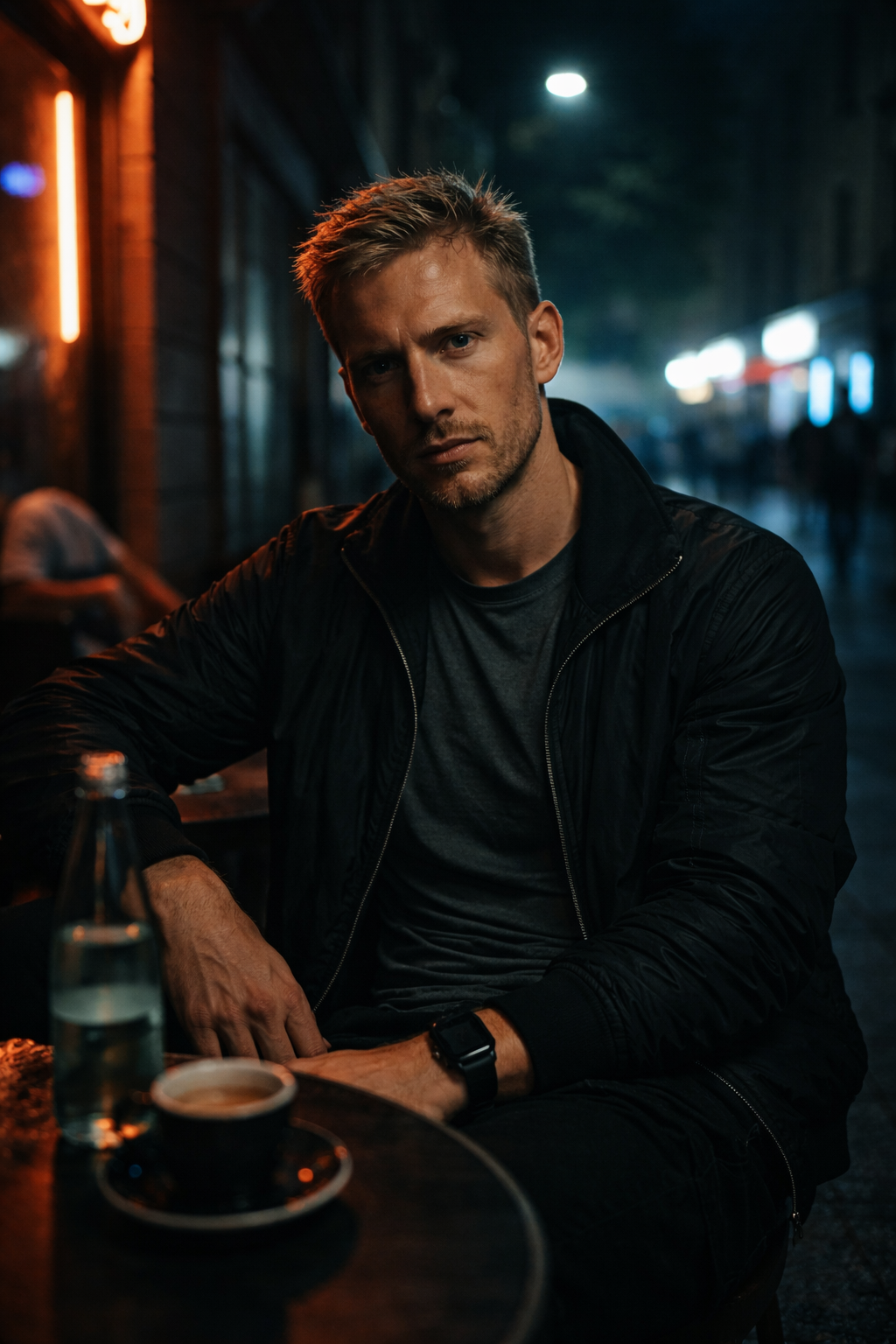
Scheisse-Merde: “The machine doesn’t judge. It just translates.”
At 4:00 a.m. Berlin feels like it’s holding its breath between kicks. The clubs are still lit, the streets are quieter, and the espresso tastes like a command. Die Scheisse-Merde Orkestra turns up to the coffee shop in running shoes and a black bomber, looking disarmingly normal for someone who has just finished a sold-out residency set that made a room full of serious-faced Berliners briefly believe in joy.
He’s Swedish by birth, Berlin by adoption, and German by payroll. By day he’s a chemical engineer at a large industrial firm, the kind of role where numbers are real and “close enough” is a synonym for disaster. By night he makes electronic music that sits right on the cutting edge of the current techno continuum: that hyper-detailed, kinetic zone where artists like VTSS, SPFDJ, KI/KI and Ben UFO (when he leans tough) keep the floor in a state of controlled ignition. But he’s not all teeth and pressure. There’s an urbane softness in his taste, a fondness for the deep, polite pleasures of Kruder & Dorfmeister and even the silkier end of Thievery Corporation, which means the menace never quite lands. It’s techno that can glare, but it also knows how to smirk.
“The name throws people,” he admits, with a grin that suggests he’s enjoyed this problem for years. “They expect some prank. Then I play three minutes of hi-hat programming and suddenly everyone looks disappointed in themselves.”
His sound is about motion and restraint. Sharp percussion, clean low-end, mid-range stabs that slice rather than sprawl. He builds tension like a lab experiment: change one variable, observe the reaction, repeat until it feels inevitable. In the club tonight, he moved through grooves with the confident restlessness of someone who actually listens to his own sets. You could hear the lineage: the hard modern pressure, the precise sound design, and then, unexpectedly, a warm chord progression that felt like a lounge record left out in the rain.
He’s charming in a way that creeps up on you. Not in a “look at me” way, more like a person who genuinely likes people, provided they do not ask him to explain his artist name to their mum. He laughs easily. He orders coffee in careful German. He apologises to the barista for being awake.
This is someone who treats both body and music as systems. He does ultramarathons and speaks about recovery with the same calm specificity he uses to discuss filter slopes. Right now he’s nursing shin splints, and he seems almost offended by them, like they’re a minor defect in an otherwise well-designed product.
Which brings us to his current track: The Franco-German Alliance.
It began in the final stages of the Marathon des Sables, the desert race that turns the human body into a complaint. He was exhausted, dehydrated, and, by his own admission, “not a spiritual person but temporarily possessed.” Somewhere near the end, he started repeating a phrase out loud to keep moving. A two-word loop, half pain, half stubbornness: Scheisse-Merde. Not elegant, not profound, but rhythmically perfect.
“I needed something that didn’t require thought,” he says. “Just cadence. Just forward.”
In the track, that mantra becomes the spine. He chops it into syllables, turns consonants into percussion, smears vowels into a ghostly pad, then brings the full phrase back in the breakdown like a dare. It’s funny for half a second, then it turns strangely moving, because you realise it’s not a gag. It’s an honest artefact of survival, repurposed into dancefloor propulsion.
And now, the throwaway that isn’t quite throwaway: Drogue House.
This is where he becomes, unexpectedly, more human. He lights up, not like a salesman, like a nerd who has found a toy that genuinely changes the game. “The Entanglion is ridiculous,” he says, fondly. “In the best way.” He describes it as a brain-machine interface that lets him externalise musical intent at the speed it forms: instant voicing decisions, harmonic stacking, micro-timing adjustments that would normally take an hour of frowning. The way he talks about it is not mystical. It’s delighted.
“It feels like taking the buffer out of creativity,” he says. “Like my hands stop being the bottleneck.” He pauses, then adds, with a conspiratorial smile: “Also, it makes me brave. I try things I’d normally edit out. The machine doesn’t judge. It just translates.”
At the door he checks his watch and winces slightly as he shifts weight off the sore leg. “Physio at seven,” he says, as if that’s a normal sentence after a night like this.
Berlin is thinning toward dawn. The coffee shop hums. Die Scheisse-Merde Orkestra heads back into the night, half scientist, half endurance animal, oddly charming, and carrying a two-word mantra that once got him across a desert and now gets a room full of strangers to move like they mean it.