

Laid Nerfon: The Quiet Beatmaker of Weed Who Hears Weather Systems in His Sleep
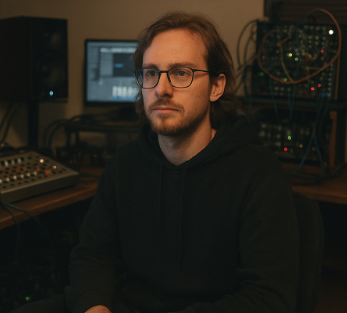
“I was trying to write something warm.”
If you take the I-5 north until the billboards thin out and the pines get tall enough to blot out half the sky, you reach the small Californian town of Weed. The residents of Weed have learned to live with the jokes, the T-shirts, and the road-trippers who stop for photos then flee. Laid Nerfon did not flee. He arrived. He stayed. Somewhere between the rumble of the freight trains and the sawmill dust drifting over toward Mount Shasta, he found the sound that has now made him the internet’s most private introvert.
Nerfon’s new track, Snow Samurai (Elegy for Glass Paw), is the sort of thing producers pretend not to like because it ruins their minimalist credentials. It is saturated with mood. The opening pads bloom like winter breath on a window. A detuned instrument of mysterious origina fractures slowly across the stereo field. On the single’s cover, a snow leopard samurai kneels in drifting flakes, staring at the snow as if praying for forgiveness. It is perhaps the only image that could match the music’s frostbitten weight.
Nerfon insists the melancholy was not deliberate. “I was trying to write something warm,” he says, hunched over a battered desk in what used to be a garage. Now it is a hybrid studio-laboratory, heavy on blinking lights and cabling that looks more medical than musical. “But the weather turned on me. October storm. Power flickered. I started hearing the track like it was breathing through cold lungs.”
His process is very Weed; long, slow, atmospheric; a man listening more than forcing. But the toolbox is surprisingly futuristic. Nerfon builds most of his beats inside a customised firmware mod of an early-2000s Japanese groove-box that no one sane still uses. Ever the geek, he’s wired it to a Raspberry Pi cluster that runs a home-rolled DSP kernel. “If it doesn’t crash at least once a session, I assume I’ve lost my edge,” he says. The Pi stack handles micro-granular slicing for what he calls “shiver harmonics,” a technique in which he stretches percussive transients until they resemble wind chimes underwater.
Under the desk sits The Thing He Doesn’t Talk About. A driveshaft of braided fibre, neatly coiled, pulsing faintly with blue light. Nerfon pretends not to notice when it emits a soft click, like a heartbeat being confirmed. “Ignore that,” he mutters. “It’s just running diagnostics.”
We indulge the fiction. Artists have their quirks. Weed is full of them.
Still, he admits the last year changed everything. Before Snow Samurai he was drifting: a cult sampler nerd without the stamina to push beyond Bandcamp obscurity. Then someone at Drogue House — no one will confirm who — pushed a prototype of the Entanglion in his direction. Nerfon shrugs as if embarrassed. “Look, I didn’t… I wasn’t one of those people who thought plugging your cortex into a signal-chain was the key to great art. I thought it was exactly the sort of tech-bro nonsense I moved up here to avoid.” He pauses. “But the latency is basically zero. You think the modulation curve and it happens. It’s like the machine just gets you. I don’t rely on it, obviously. It’s just… helpful.”
A throwaway line, offered too casually, the way guitarists in old interviews used to mention a pedal they swore they never used. Although the sessions for Snow Samurai ran long, Nerfon insists the melancholy came from him, not his hardware. Even so, the Entanglion looms there, coils glowing quietly in the half-dark, as if listening.
Weed’s most reclusive beatmaker is having a moment. And whether he likes it or not, so is whatever he has wired into his nervous system.